
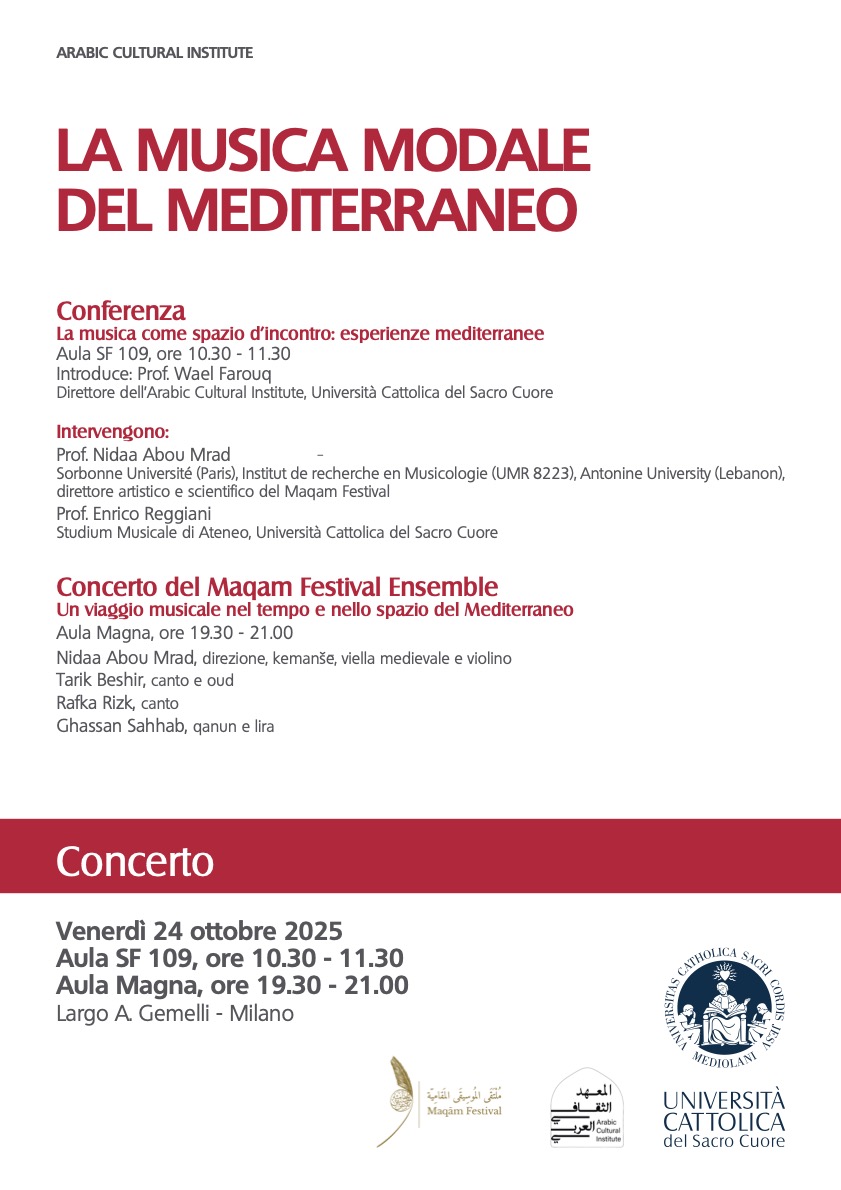
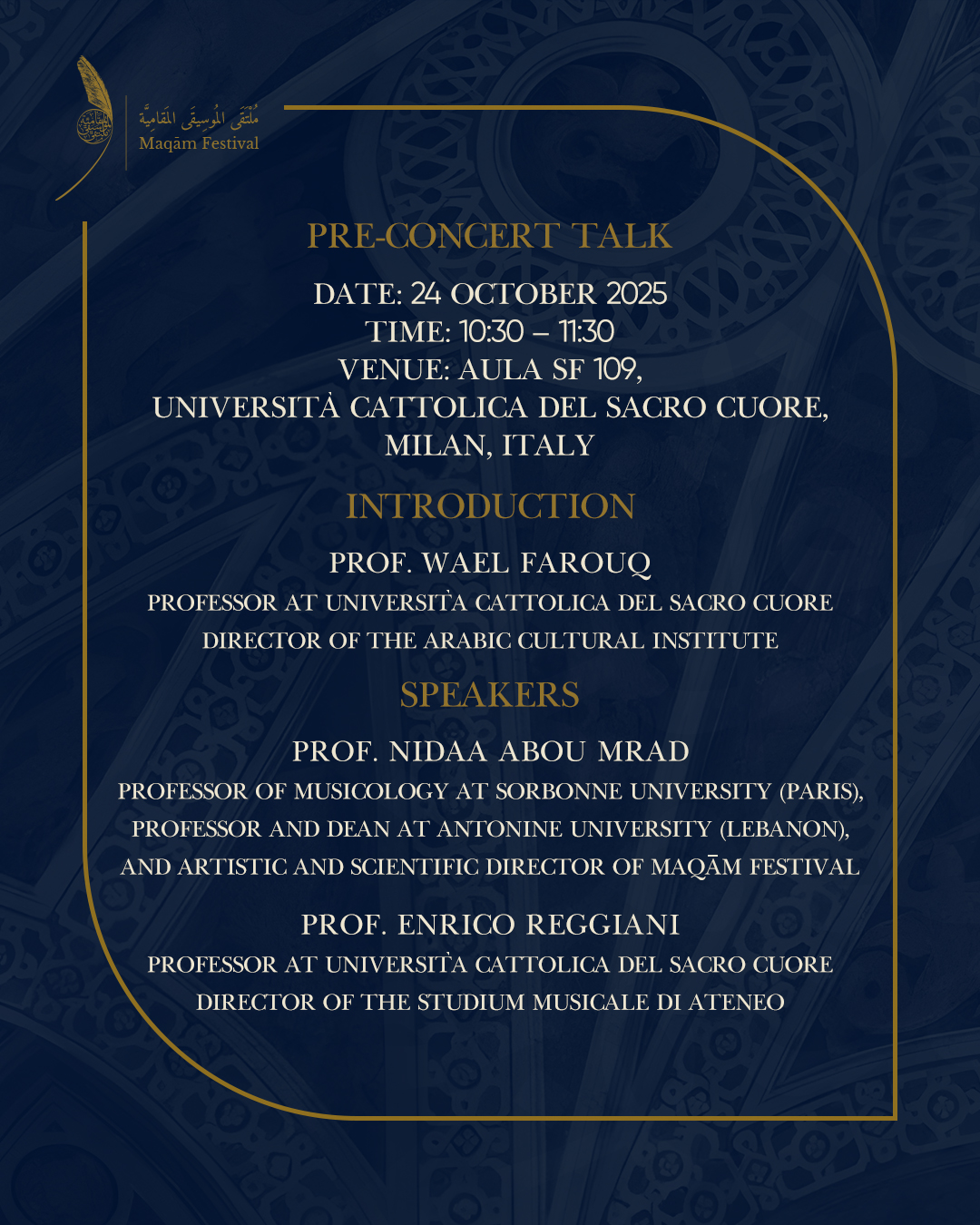
Concert & Pre-Concert Talk
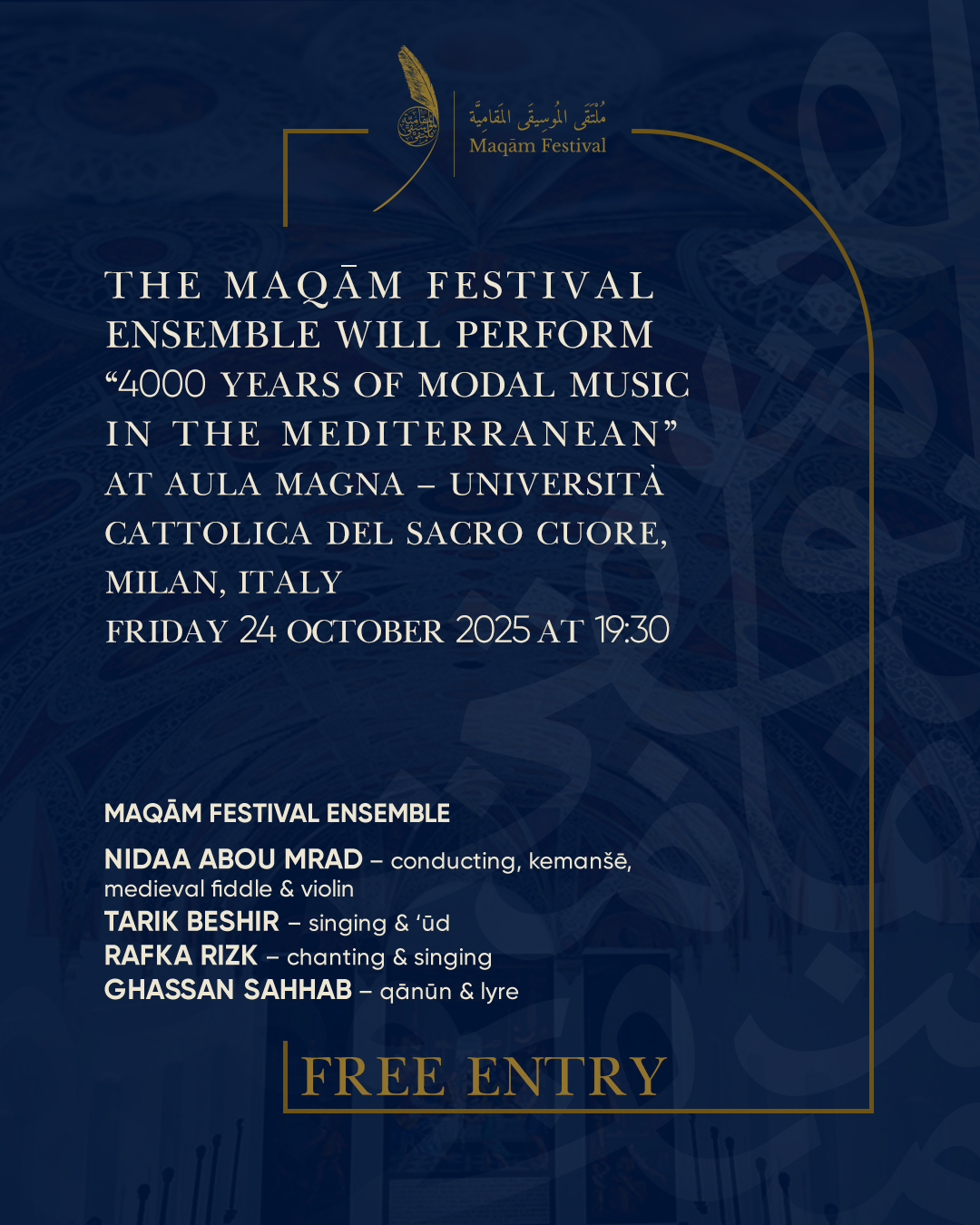
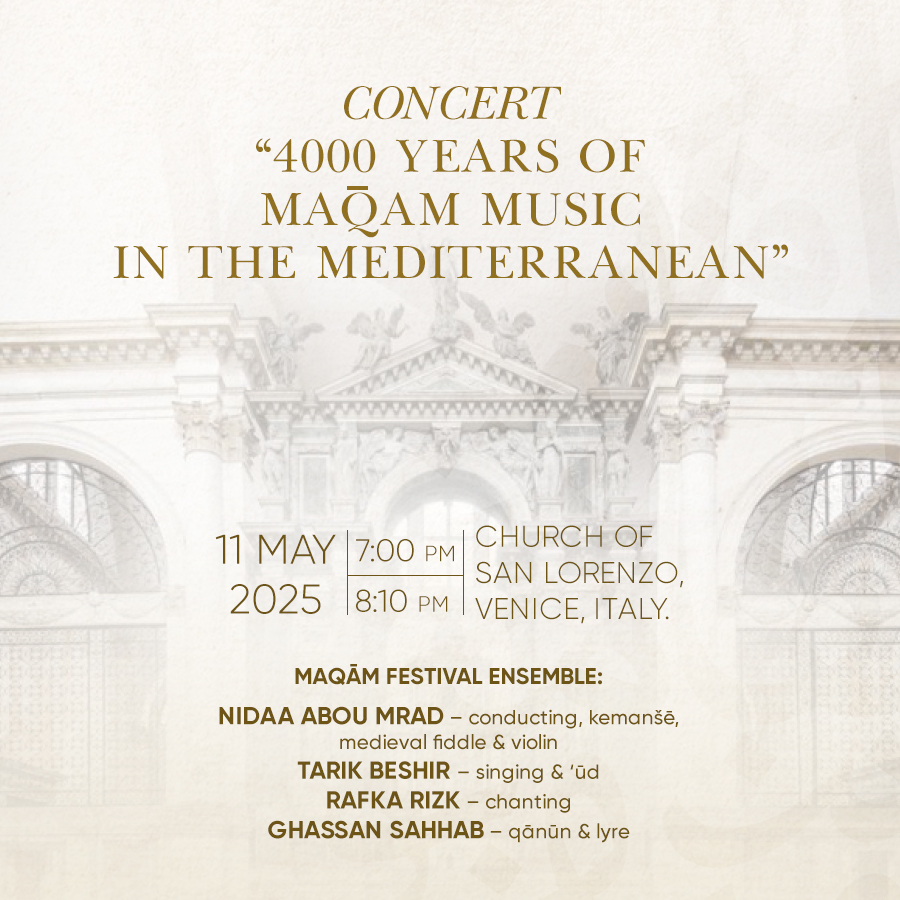
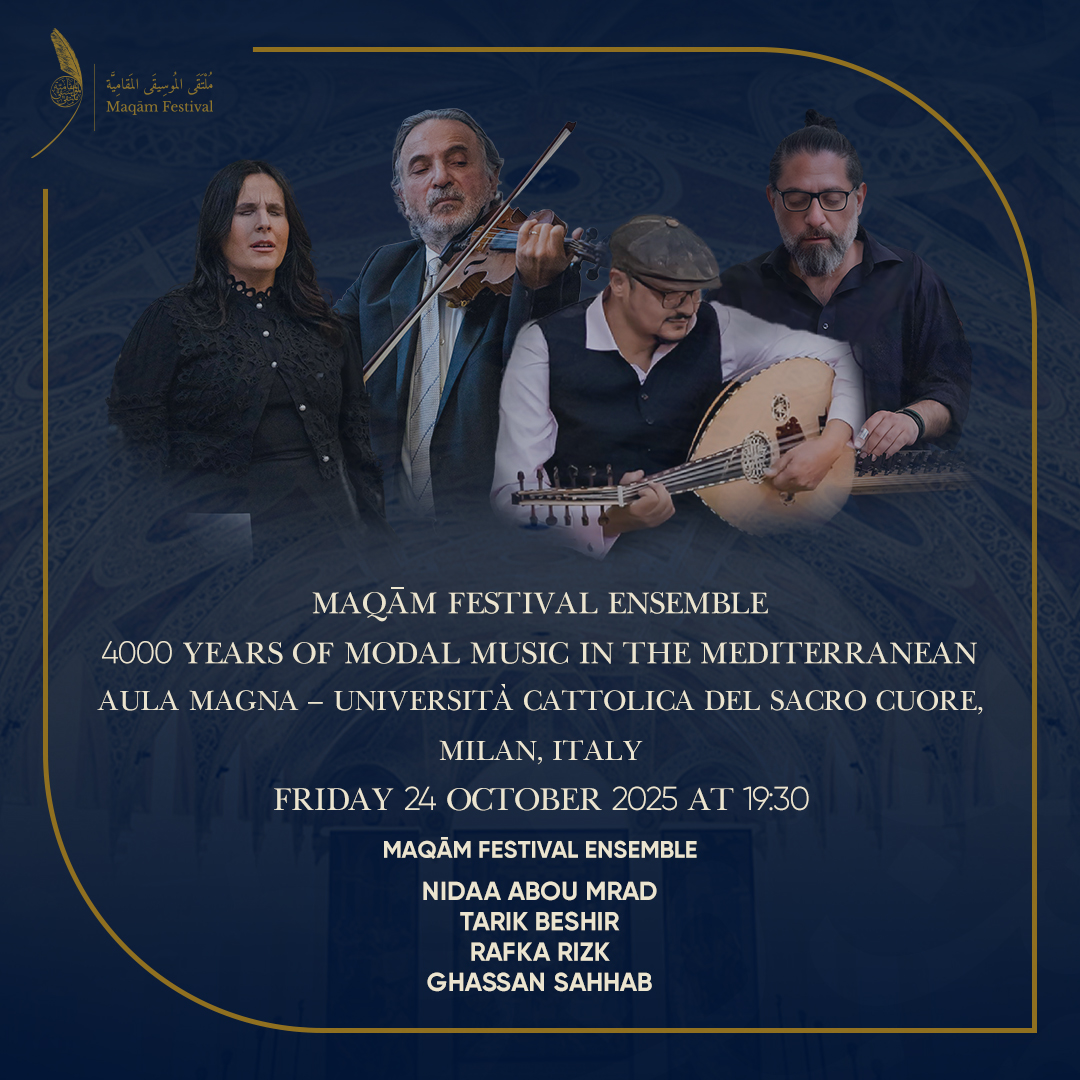
4000 Years of Modal Music in the Mediterranean
In collaboration with the Arabic Cultural Institute & Università Cattolica del Sacro Cuore.
Date: 24 October 2025 at 19h30 (75 min). Public Concert
Location: Aula Magna, Università Cattolica del Sacro Cuore, Milan, Italy
Maqām Festival Ensemble
Nidaa Abou Mrad, kemanšē, medieval fiddle & violin
Tarik Beshir, singing and ‘ūd
Rafka Rizk, chanting
Ghassan Sahhab, qānūn & lyre
Maqām Festival Ensemble
Introduction
The musical traditions of West Asia, North Africa and Medieval Europe are based on a common modal melodic system. The maqām mode of a traditional musical work provides the melodic alphabet and the typical formulas from which the phrasing is elaborated, at the same time as it colours the emotions conveyed, inducing ecstasy. If these great traditions converge on the level of this common melodic system, similar to the trunk of a very old tree, their cultural diversity is expressed by the traces that the prosody of the sung languages and the ritual and choreographic gestures, specific to the contextual cultures, leave in their rhythm and their musical styles and forms, thus generating a multitude of traditional musical branches. Indeed, the concert “4000 Years of Modal Music in the Mediterranean” offers an initiatory journey through musical history, summarizing-in seven stations-the branching evolution of modal music across the Mediterranean region.
First Station: Pagan Antiquity
The first station, that of Antiquity, begins in Ugarit (Syrian coast), around 1500 BC, with the Hurrian Hymn H6, addressed in Nidqibli mode to the goddess Nikkal, the first written music in human history, in cuneiform notation, composed by Urhiya, transcribed by Richard Dumbrill and realized by Nidaa Abou Mrad.
This station continues with a Greek hymn of the 1st-2nd century AD, the Epitaph of [the composer] Seikilos, inscribed in alphabetical musical notation on a stele at Tralles in Asia Minor.
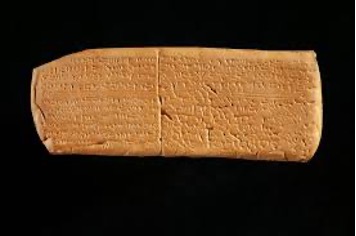
Hurrian Hymn H6
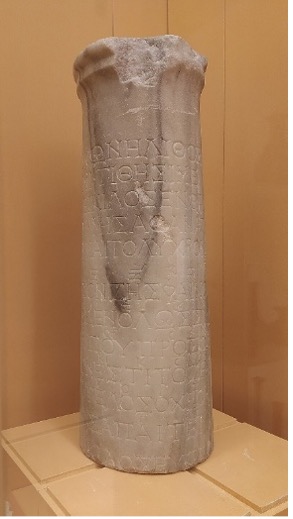
Epitaph of Seikilos
Second Station: Ancient and Medieval Christian Songs
- Hymn to the Holy Trinity from the manuscript of Oxyrhynchus (P. Oxy. XV 1786, found in Egypt) of the end of the third century, hymn noted according to the ancient Greek vocal notation,
- Hymns of the Nativity “Šubhō l-haw qōlō” of the Syriac Maronite and Syriac Orthodox liturgies (oral tradition of Saint Ephrem),
- Golgotha Hymn of the Coptic Orthodox Holy Week liturgy,
- Paschal Apolytikion in the Eastern Orthodox Roman Liturgy,
- Offertorium “Jubilate Deo” in Gregorian chant, interpreted according to the neumatic notation of the Abbey of Saint Gall (9th century), in modal symbiosis with the Oriental Christian chants.
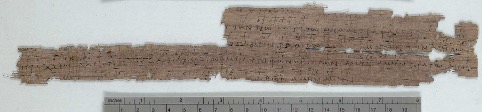
Manuscript of Oxyrhynchus, P. Oxy. XV 1786, Sackler Library in Oxford
Third Station: Music from the Abbasid Era
The third station is that of instrumental and vocal music of the late Abbasid era (based on the alphabetical and numerical musical notation of Ṣafiy ad-Dīn al-Urmawī (1216-1294):
- Ṭarīqa wa-ṣawt [prelude and singing in mode] min Nawrūz fī ḍarbi r-ramal, composed by Ṣafiy ad-Dīn al-Urmawī, transcribed by Nidaa Abou Mrad);
- Ṭarīqa wa-ṣawt Ḥusaynī ramal on the poem of the Religion of Love by Muḥyi d-Dīn ibn ‘Arabī (1165-1240), musicalized in the Abbasid style by Nidaa Abou Mrad;
- Ṭarīqa wa-qawl [prelude and singing] “Yā malīkan”, in mode Muḥayyar al-Ḥusaynī, composed by Ṣafiy ad-Dīn al-Urmawī, written in alphabetical and numerical musical notation by Quṭb ad-Dīn aš-Šīrāzī, transcribed by Owen Wright.
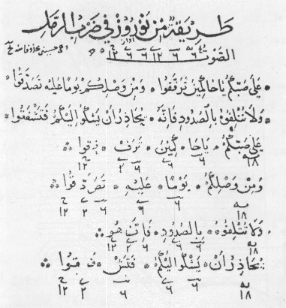
Alphabetical and numerical musical notation of Ṭarīqa wa-ṣawt min Nawrūz fī ḍarbi r-ramal, at the end of Ṣafiy ad-Dīn al-Urmawī’s Book of Cycles
Fourth Station: Maghreb-Andalusian Music
The fourth station is that of Maghreb-Andalusian music, according to the Tunisian Ma’lūf tradition:
Chanting the the first bayt (verse) of the Nawbat al-Ḥusayn, attributed to Sheikh Abū Madyan Šu‘ayb al-IŠbīlī (d. 1198);
Chanting the qaṣīda “Arāka ṭarūban”, referring to the interpretation of Aḥmed el-Lawz (1913-1958).
Fifth Station: French and Spanish Music from the 13th Century
The fifth station is that of the Cantigas de Santa Maria, songs composed in the 13th century by Alfonso the Wise, king of Castile and troubadour, in collaboration with Christian, Muslims and Jews musicians, interpreted here in symbiosis with the modality of maqam:
- instrumental prelude " La quinte estampie réale " (13th century France),
- Cantiga 322 “A Virgen”.
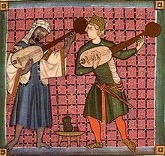
Miniature illustrating the collection of Cantigas de Santa Maria
Sixth Station: Italian Trecento
The sixth station is that of the Trecento, with an Italian instrumental music of the 14th century, the Lamento di Tristano (MS Additional 29987, British Library) and a musical paraphrase of the end of Dante Alighieri’s Divine Comedy.
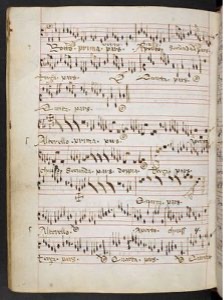
The manuscript of Lamento di Tristano (MS Additional 29987, British Library)
Seventh Station: Sufi and Secular Music from the Arabian Nahda Era
The seventh station is that of instrumental and vocal music of the Nahḍa era (Arab cultural renaissance 1798-1939), particularly during the period 1768-1932. In fact, The Arabic instrumental and vocal art of maqām music has known two golden ages, in the Abbasid era and in the Nahḍa era. The Egyptian singer, improviser and composer 'Abdu al-Ḥamūlī (1843-1901), surrounded by singers and instrumentalists from Egypt and the Levant, replanted the maqām tree in the Nile Valley, after a long period of creative hibernation. Like the endogenous hybridizations that have characterized the reforming dynamics of the Nahḍa in different cultural fields, this revitalization was made by hybridizing four homogeneous musical grafts: (1) the Levantine artistic musical tradition, (2) the Egyptian popular musical tradition (3) the Sufi musical tradition, and (4) the Ottoman artistic musical tradition. From this endogenous mixing comes a hybrid musical form, the waṣla, which is a canonical dialectical path: (I) thesis of measured precomposed (instrumental and vocal) preludes; (II) antithesis of unmeasured improvisations in the cantillation style of taqsīm, yā lēl and mawwāl; (III) synthesis of semi-improvised responsorial vocal forms, performed by the taḫt (a chamber music ensemble).
The first waṣla will be developed in arborescence from maqām Rāst, with,
- in thesis, taḥmīla Rāst (semi-improvised instrumental form) and muwaššaḥ “Aḥinnu šawqan” (vocal composition),
- in antithesis, cantilled improvisation instrumental (taqāsīm) and vocal (“Yā lēl” and mawwāl “Yā ahl-il- ġarām”) in maqām Rāst, and,
- in synthesis, dōr (semi-improvised responsorial form) “Aṣli l-ġarām”, composed by Muḥammad ‘Uṯmān (1855-1900).
The second waṣla will be developed in arborescence from maqām Ḥijāz, with:
- Taḥmīlat Ḥijāz – Nahḍa Tradition, Sami Chawa (1885-1965), a concertante improvised responsorial instrumental form ;
- Sufi qaṣīda (poem) of the (mystical) “Two Loves” by Rābi'a al-'Adawiyya (713-801), musicalised by Nidaa Abou Mrad.
The final sequence consists of a tawšīḥ in maqām Sīkāh, based on verses from the Song of Songs (Veni de Libano, sponsa mea: veni de Libano, veni, coronaberis: de capite Amana, de vertice Sanir et Hermon, de cubilibus leonum, de montibus pardorum) musicalised by Nidaa Abou Mrad
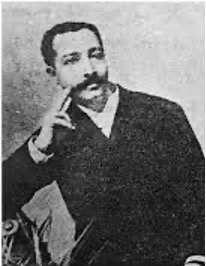
'Abdu al-Ḥamūlī (1843-1901)
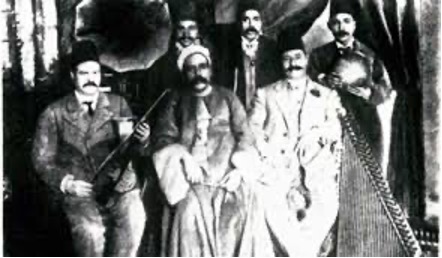
Šayḫ Yūsuf al-Manyalāwī (1850-1911) with Muḥammad al-‘Aqqād’s taḫt
Programs


مُلْتَقَى المُوسِيقَى المَقامِيَّة
P.O. Box 288
Postal Code 12311 Dokki
Giza, Egypt
Multaqa al-Musiqa al-Maqamiyya LLC
P.O Box 35938, Dubai, UAE
Tel./whatsapp: +20 109 0379090
info@maqamfestival.com
www.maqamfestival.com
©2023-2026 Maqām Festival. All rights reserved.